



















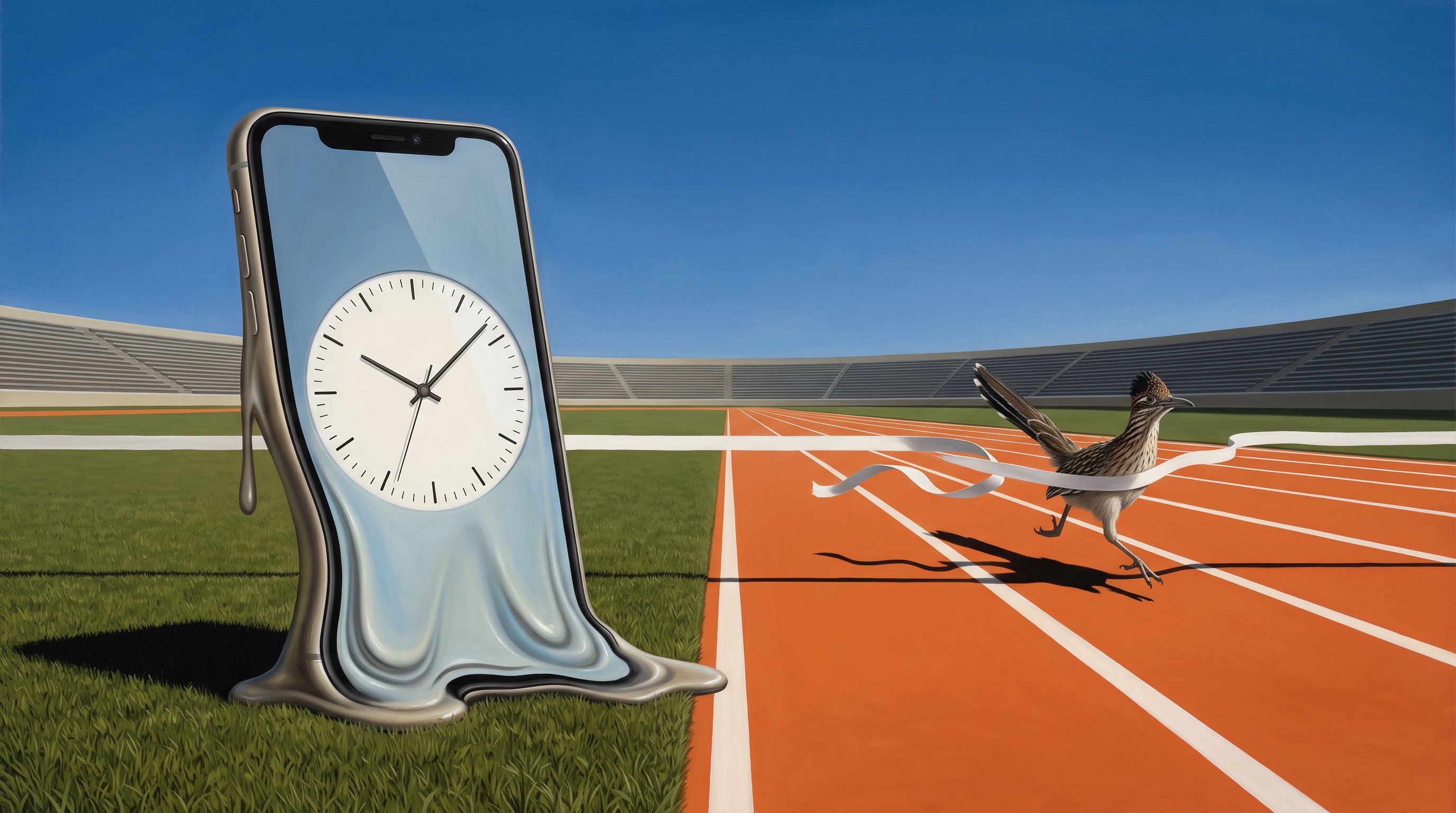
You want to time something: a lap, a boil, an experiment, a friend’s attempt. You have a phone and a thumb. This is a guide to the most honest number that equipment can give you — which starts with knowing what it costs you.
Because it costs. Between the thing you are timing and the moment it is recorded sit two delays you cannot remove: your nervous system and your screen. Everything else is negligible by comparison or fixable by method. First the budget, then the craft.
The thumb: about 200 milliseconds
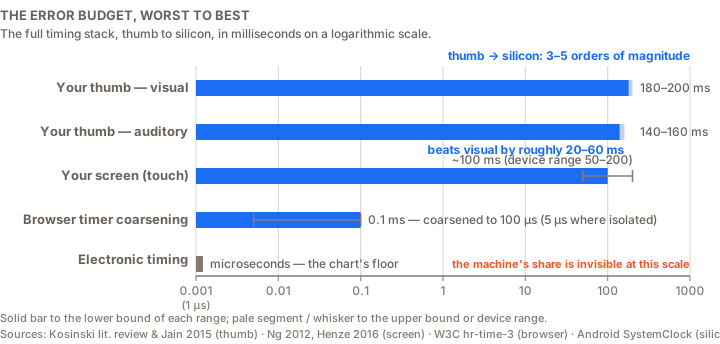
A healthy adult reacting to something they can see takes roughly 180–200 milliseconds to begin responding — the classic laboratory figure. A modern study of 1,469 adults that corrected for the measuring hardware itself landed on about 200 ms in the youngest group, rising toward 222 ms in the oldest. React to a sound and you are faster: roughly 140–160 ms, measured within the same people, every time. Sound beats sight by a good fraction of a tenth of a second — one of the most usable facts in this post.
Two caveats keep those numbers honest. They are simple reaction times — one stimulus, one response, measured in a lab. And they describe healthy adults generally, not sprinters. When researchers analysed every sprinter at the 2008 Beijing Olympics, the fastest valid reactions averaged 166 ms for men and 189 ms for women: the fastest people in the world, at their fastest, sit on the ordinary lab range.
If you have taken an online reaction test and scored 270-odd, that is a different population — self-selected people on uncontrolled hardware — and if you scored under 150, you almost certainly clicked before the signal: a false start.
Is 100 milliseconds impossible? (The sport’s own argument)
Track and field treats any block reaction under 100 milliseconds after the gun as a false start — a rule, not a physiology claim, and the sport itself argues about it. The Beijing analysis concluded that at high statistical confidence nobody reacted that fast: lower bounds of 109 ms for men, 121 ms for women. But research the sport’s own federation commissioned went the other way, confirming earlier reports of auditory reactions as fast as 80 ms and recommending the limit be lowered. Where the rulebook draws the line and where human ability ends are different questions — and both answers sit tens of milliseconds below the ordinary 200, nowhere near the hundredths your stopwatch displays.

The screen: about 100 more
The thumb is half the budget. The other half is the phone itself: on consumer touchscreens, the delay between a finger touching the glass and the system registering it runs 50–200 milliseconds across mainstream devices, centered near 100. Your tap is not instantaneous, and neither is the phone’s listening.
Add it up: roughly 300 milliseconds of unremovable delay between “it happened” and “the timer knows.” This is why the decimals on the display — honestly earned as they are — record the wrong moment with great precision.
Perception is not reaction
One more number, because it is misquoted constantly: the brain can identify the concept of an image flashed for as little as 13 milliseconds. It is a perception result — recognition, not movement — and the same researchers note that merely deciding where to move your eyes takes 100–140 milliseconds. It says nothing about buttons.
Laps and splits: name what you want before you start
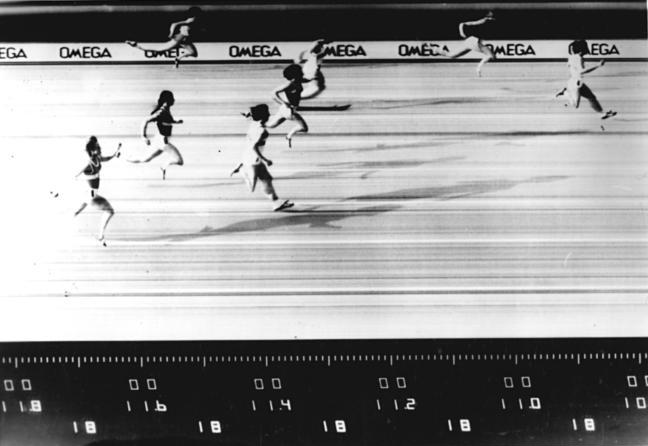
Timing a whole thing in one number is the blunt instrument. The moment anything runs longer than a few minutes, you want waypoints, and there are two kinds, endlessly confused:
- A split is elapsed time from the start up to a waypoint. Cumulative.
- A lap is the time of one segment, between two waypoints.
The full anatomy of the confusion has its own post. The practical rule: decide which you will care about before you start, and tap a waypoint at every milestone regardless — it is easier to ignore a split you logged than to recover one you didn’t.
What the phone is actually good at
Here is the part that surprises people: the clock is not your problem. A phone measuring an interval uses a monotonic clock — one that counts forward from boot and is guaranteed not to jump when the network corrects the wall clock.
When people say “phones drift,” they are talking about the wall clock — a different clock, doing a different job — and its drift says nothing about the clock that measures the gap.
(Web apps are the exception: browsers deliberately blur their high-resolution timers to 100-microsecond steps for security reasons. Native apps are not so coarsened.)
So the stack, worst to best: your reaction (~200 ms), your screen (~100 ms), then everything electronic — microseconds, effectively perfect by comparison. The error budget of a timed interval is a human budget.
Which errors cancel, and which quietly don’t
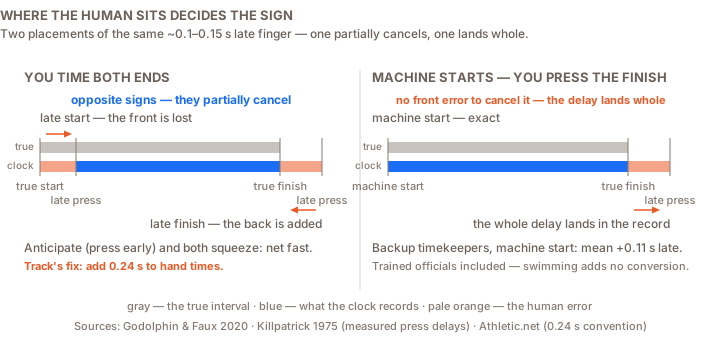
Now the craft. Two facts about human timers, both measured, pointing in opposite directions:
- In track, hand times run fast. The timer reacts late to the start and anticipates the finish — pressing slightly before the athlete crosses — and the anticipation wins. The sport’s conversion convention adds 0.24 seconds to hand times for races under 300 m precisely because of it. (Why exactly 0.24? It is a convention; the origin story traces to a study nobody seems able to produce. The convention is solid; treat the mechanism as folklore with a measured outcome.)
- In swimming, backup timekeepers pressing a button at the touchpad — machine start, human stop — run late: about 0.1 to 0.15 seconds on average, trained officials included.
Same species, opposite signs. What differs is where the human sits: time both ends yourself and your errors partially offset; hold the finish for a machine-started event and your delay lands in the record whole. The rule: name both ends of every interval you time — who started it, who stopped it, and whether the stopper could see it coming.
From which, the practice:
- Let machines own the starts they can. An electronic start — a gun sensor, a pad — removes the error nothing else cancels.
- Prefer sound to sight. Auditory reaction beats visual by roughly 20-60 milliseconds in the same person.
- Anticipate deliberately. Spend your reaction before the line instead of after it — watch the approach, not the clock.
- Tap waypoints, then name them. They cost nothing at the moment and everything afterwards if missing.
- Time the same way every time. Differences between runs survive a constant bias; an inconsistent method with no bias survives nothing.
The honest number
None of this makes a thumb-pressed interval accurate to the hundredth it displays — nothing could, and the history of how timing escaped the human thumb is the history of machines taking over the endpoints. What method buys you is known bias, known direction, and clean differences between measurements. That is what an honest interval is.
When you press start on TiCaNo Stopwatch, the clock underneath is the good part of the stack — the microseconds part, not the milliseconds part. The thumb is yours; the waypoints, the laps and splits, the naming and the export are the app’s. Between the two of you, that is the whole craft.
Sources
- A Literature Review on Reaction Time — Kosinski, Clemson University
- Visual and auditory reaction times — Jain et al. (2015), the same-people auditory advantage
- Factors influencing the latency of simple reaction time — Woods et al. (2015), the corrected ~200 ms
- Beijing Olympics sprinter reaction times — Lipps et al. (2011), the 166/189 ms bounds
- Elite sprinters in world championships — Tønnessen et al. (2013)
- IAAF Sprint Start Research Project — World Athletics (2009), the 80–85 ms case
- Swim timekeeper performance — Godolphin & Faux (2020), +0.11 s; with Pacific Swimming’s Killpatrick 0.15 s analysis
- Hand Time Conversion Standards — Athletic.net, the 0.24 s convention
- Split Times and Lap Times — Casio manual
- Software-Reduced Touchscreen Latency — Henze et al., ~100 ms touch; with Ng et al., UIST 2012, 50–200 ms
- SystemClock — Android reference, the monotonic guarantee; with clock_gettime(2)
- High Resolution Time Level 3 — W3C, browser timer coarsening
- In the blink of an eye — MIT News (2014), the 13 ms perception finding
- Human Benchmark reaction time — ReactionTimeTests.org (2026), the ~270 ms online median